Mandalay tests your patience with heat and history. It rewards families who move slowly, eat locally, and accept the rhythm of the Irrawaddy.
The train from Yangon does not arrive on time; it arrives when the distance has been conquered. The 716-kilometer journey to Mandalay, Myanmar, takes between 14 and 18 hours. This is an endurance event that strips away the urgency of modern travel. For a family, this is the first lesson of the city: outcomes are not controlled by schedules, but by the machinery of the state and the weight of the rails. You arrive at Mandalay Railway Station not refreshed, but changed. The air is thick, smelling of diesel and dust. The children are quiet, worn down by the vibration of the carriage. This is the correct state of mind for Mandalay. It is a place that does not entertain; it endures.
The Weight of History
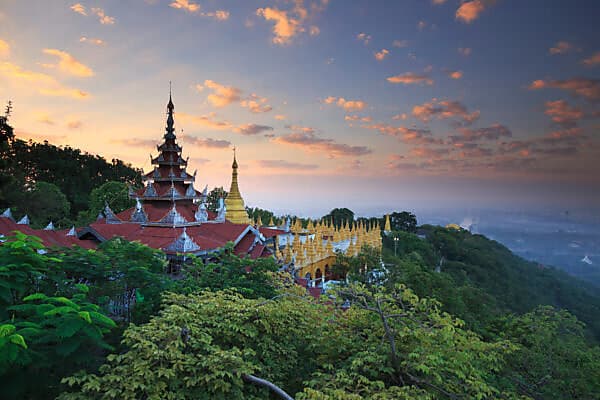
Mandalay is built on layers of inevitability. The city’s layout is a grid imposed on a landscape that resists order. At the center of this tension stands Mandalay Hill. The climb is steep, the stone steps worn smooth by generations of bare feet. For a family, the ascent is a negotiation. Children tire quickly. Parents hesitate. But the summit offers a view that justifies the friction. You see the city spread out below, a chaotic tapestry of red brick and corrugated iron, bounded by the slow, brown flow of the Irrawaddy River. The river does not care about your plans. It moves with a heavy indifference that defines the region.
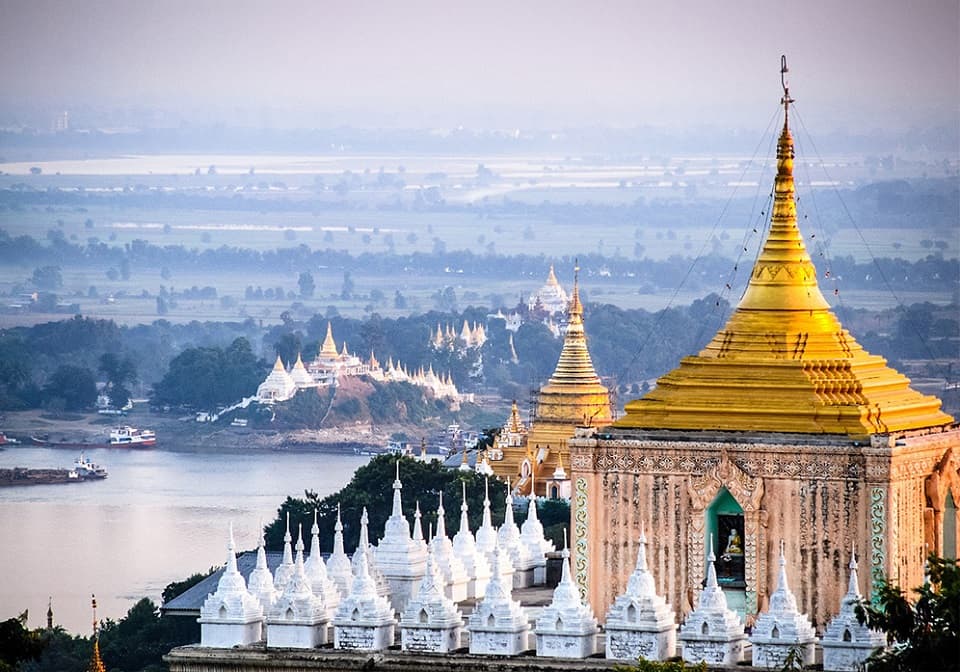
Nearby, Kuthodaw Pagoda stands as a monument to human obsession. It is known as the world’s largest book, composed of 729 marble slabs inscribed with the Tipitaka. The silence here is absolute. It is a holding space for strangers pretending they understand the scale of faith. For children, the repetition of the stupas is hypnotic. There is no rush here. You walk the perimeter. You read the inscriptions if you can, or you watch the light fade on the marble. It is a lesson in permanence. The stone will outlast the visitor. This is a comforting thought for parents who worry about the fragility of childhood. In Mandalay, nothing is fragile. Everything is fixed.
The Bridge and the Market
U Bein Bridge is the most photographed structure in Myanmar, but photographs do not capture the danger. It is a teakwood footbridge spanning Taungthaman Lake. The wood is old, the planks uneven. Crossing it is an act of trust. You step onto the bridge, and you commit to the other side. There are no railings. There is only the gap between the plank and your foot. For a family, this is a moment of shared focus. Children learn to watch their step. Parents learn to let go of the need to control the path. The sunset here is a convergence of light and shadow that marks the end of the day’s gamble.
The market at Sandamuni Pagoda is a different kind of test. It is loud, crowded, and chaotic. It is a convergence point where people gamble with chance. You navigate the stalls, buying snacks, bargaining for prices. The air smells of fried dough and spice. Children are overwhelmed by the sensory input. This is good. It forces them to engage with the reality of the place. You buy a local snack, perhaps a sweet treat from a vendor who has been there for decades. You eat it standing up. There is no comfort here, only sustenance. The pagoda itself is notable for its intricate wood carvings, but the real attraction is the energy of the crowd. It is a reminder that life in Mandalay is a collective effort.
The Rules of Eating
Food in Mandalay is not about aesthetics. It is about survival and tradition. The local cuisine is dominated by noodles, a testament to the city’s connection to the Shan state. Mee Shay is the most famous dish, originating from the Shan people in Eastern Myanmar. It is rice noodles with toppings and meat sauce. The broth is rich, the noodles slippery. It is eaten quickly, often from a plastic bowl on a plastic stool. For a family, this is a lesson in humility. You do not sit in a restaurant with air conditioning. You sit on the street, surrounded by locals. You eat with your hands or a spoon. The taste is intense, salty, and savory. It is not subtle.
Mandalay Monti is another staple, a noodle dish that defines the city’s palate. Khotaung Monti is a variation, each with its own texture and flavor profile. These are not dishes for tourists; they are dishes for residents. To eat them is to participate in the daily ritual of the city. Shan traditional dishes are also available, offering vegetarian and non-vegetarian options. The food is simple, but it is honest. There is no pretense. You pay a small amount, you eat, you leave. The transaction is complete. For children, the novelty of the flavors is enough. They do not need to understand the history of the Shan people to appreciate the taste. They only need to know that the food is real.
The Journey In
The train is the only way to truly arrive in Mandalay. Flying is an escape. Taking the train is an engagement. The Myanma Railways Yangon–Mandalay Express, Train No. MR 5, is the specific service that carries the majority of travelers. It is not luxurious. The seats are hard, the windows are small. But it is reliable in its unreliability. You know it will be late. You know it will be crowded. You know it will be hot. This certainty is a comfort. You can plan around the chaos. The fare starts from approximately $18 USD, a price that reflects the value of the experience, not the comfort.
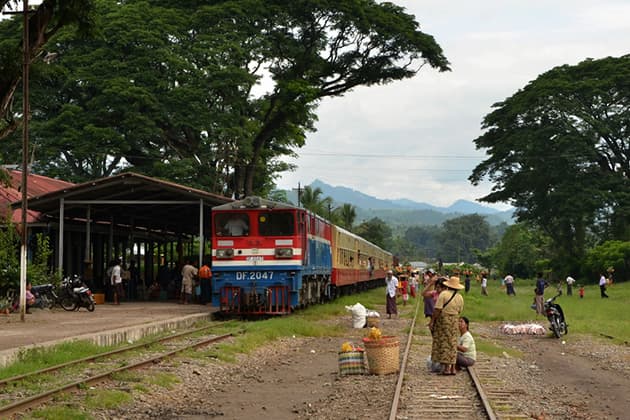
The journey takes between 14 and 18 hours. This is not a typo. It is a fact. You spend two days on the train. You watch the landscape change from the delta of Yangon to the plains of Mandalay. You meet other travelers. You share food. You sleep when you can. For a family, this is a bonding experience. The children learn to adapt to the rhythm of the train. The parents learn to relax. There is no internet, no distraction. There is only the present moment. The distance of 716 kilometers is measured in hours, not miles. It is a physical manifestation of the separation between the two largest cities in Myanmar.
When to Go
There are no holidays in the next six months that will disrupt your travel plans. This is a blessing. You can travel without the pressure of crowds. The best time to visit Mandalay is the dry season, from November to February. The heat is less intense, the rain is absent. But even in the summer, the city has its own logic. The heat is a test. It forces you to move slowly. It forces you to rest. For a family, this is a lesson in patience. You do not rush. You accept the heat. You find shade. You drink water. You survive.
Mandalay is not for everyone. It is for those who understand that travel is not about comfort. It is about confrontation. You confront the heat. You confront the history. You confront the poverty. And you confront yourself. For a family, this is a powerful experience. It teaches resilience. It teaches empathy. It teaches respect. You leave Mandalay changed. You carry the weight of the city with you. You remember the taste of the Mee Shay. You remember the view from Mandalay Hill. You remember the silence of Kuthodaw Pagoda. These are not memories. They are facts. And facts are the only things that matter.
Practical Questions
Is the train safe for children? Yes. The train is crowded, but it is safe. Keep your children close. Watch their steps. The platform can be slippery. The carriage can be hot. But the risk is manageable.
What should we eat? Start with Mee Shay. It is the most accessible dish. Try Mandalay Monti if you want a local favorite. Avoid street food that looks unsanitary. Trust your instincts.
How much money do we need? Budget around $20–30 USD per day for food and transport. The train fare is separate. Cash is king. ATMs are unreliable. Bring enough USD to exchange upon arrival.